
By Diego Almao
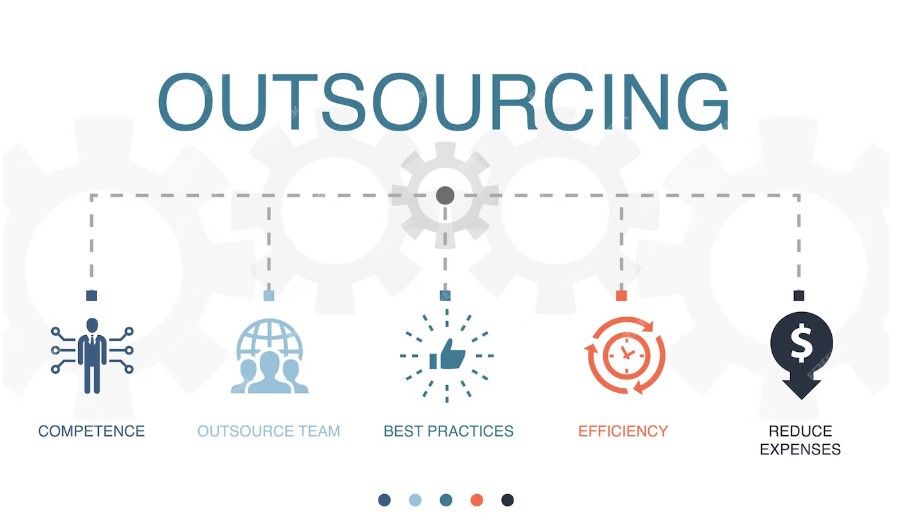
Outsourcing is a common practice in the business world. It consists of delegating certain functions or tasks to external providers instead of handling them internally.
It’s true that outsourcing offers interesting benefits for companies’ finances, as well as in terms of manpower and talent for the execution of tasks and projects. However, it also presents challenges companies should consider carefully.
One by one, let’s take a look at some of the main benefits and potential risks when outsourcing processes in our companies.
Pros
Many companies are already familiar with it. When processes are outsourced, it’s possible to have a new boost due to several factors: high level talent at lower costs, development of core activities in the company, and a more flexible approach to possible changes in the industry.
Reduce payroll expenses
By outsourcing, companies can reduce the costs associated with hiring and maintaining in-house staff. There is no need to pay salaries, health insurance, training, travel compensation or other expenses associated with full-time employees.
When certain processes are outsourced, it’s possible to have very high-level talent in key processes at a lower-than-expected cost.
Prioritize core operations within the business
By delegating non-core tasks, companies can concentrate on their core activities.
It has happened to all of us that we keep putting off activities or tasks that, although important, are not urgent for the current situation, causing us to put them off until there is nothing else to take care of.
When you outsource processes and tasks outside your company, your agenda is freed up so that you have more time to take care of what really matters and will allow you to move towards business growth and success.
You have access to global talent
Along with cost reduction, another great benefit of outsourcing is being able to draw on talent from anywhere in the world.
Think of it this way. You quickly need a customer experience specialist for your company, but you can’t find the profile you consider ideal for the job. In this scenario, the quick solution is to outsource this position until you can manage it in-house.
With outsourcing, you have access to experts and professionals specialized in different areas, even if they aren’t physically in the same location. This expands the talent available to the company.
Flexibility
Outsourcing allows companies to adapt quickly to changes in demand or in the market. They can increase or decrease the amount of contracted services as needed.
Think of outsourcing as a suit of armor or combat suit. Depending on how you want to perform, you can add or remove certain add-ons so that you can adapt to circumstances and remain competitive in your industry.
Streamlining of work
Delivering products or services on schedule is easier when employees have more time available. Depending on the project, deliveries may occur days or weeks ahead of schedule, allowing people to breathe and get some rest before the next important process.
As long as you maintain your quality standards, streamlining your work will allow you to meet your goals faster.

Cons
Not everything is good when you outsource processes. It’s true that your costs may go down and you’ll have more time to focus on core activities, but you’ll have that in exchange for possible coordination and product quality issues. Let’s look at this in more detail.
Security risks
When a company decides to outsource certain functions or services, such as data management or technical support, it exposes itself to security risks.
Why? Because by relying on an external provider, sensitive and confidential data is shared. If that provider doesn’t have adequate cybersecurity measures in place, there could be data leaks or breaches.
The risk is not as great when you outsource marketing, for example, since the area doesn’t tend to handle sensitive company data or information, or at least it should not. This is a reason why it’s one, if not the most, frequently delegated area to people outside companies.
Lack of control
Outsourcing involves relinquishing some control over business processes. Although it can be advantageous in terms of efficiency and costs, it also means the company doesn’t have direct control over how certain tasks are performed.
This can lead to frustration or concern, especially if the results don’t meet expectations. It’s critical to establish clear agreements and closely monitor the performance of outsourced services.
Communication challenges
Effective communication is essential in any organization. Communication allows us to understand the corporate culture, values, vision and purpose that drive everyone as a company.
However, when processes are outsourced, communication obstacles can arise. Physical distance, cultural differences and time zones can make coordination between the company and the outsourcer difficult.
It’s crucial to establish solid communication channels and maintain a close relationship to avoid misunderstandings and ensure everyone is aligned on objectives.
Quality issues
The quality of the work delivered by an external provider can vary. Sometimes, companies choose to outsource to save costs, but this could affect the quality of the products or services. If you don’t establish clear standards and constant monitoring, you’ll have problems.
You’ll lose more than you gain if you prioritize cost reduction over product quality. It’s best to balance both.
Possible internal resistance
Something that isn’t often talked about is that internal company employees, in some cases, might feel uncomfortable if their job is passed to someone outside the company.
Think about it, how would you feel if one day you were told the work you do will be done by someone who is not part of the company?
If there is no transparent communication from management, there can be misunderstandings that can damage the work environment.
To summarize, outsourcing can be beneficial, but it also carries risks. Companies should carefully weigh these issues before deciding whether to outsource certain processes.
Remember that every organization is unique, and what works for one may not be the best option for another. Not all companies can or should outsource processes at any given time, and for others, it will be a necessary and almost mandatory step to continue growing and advancing in their sector and internally.
¿Buscas un sitio para concentrarte y sacar adelante tus proyectos?
ULab es el espacio de coworking en pleno centro de Alicante para emprendedores, autónomos y equipos en remoto. Puestos flexibles, oficinas privadas, salas de reuniones y una comunidad de verdad.











0 comentarios