An empathy map to get to know your customers better (step by step, with an example)
Updated: 21 October 2026
The most important thing in any business is knowing who you’re selling to. Not their age and postcode, but what worries them, what they want and what they actually do when no one’s looking. An empathy map is one of the simplest tools to get there, and you only need a sheet of paper and an hour.
What is an empathy map?
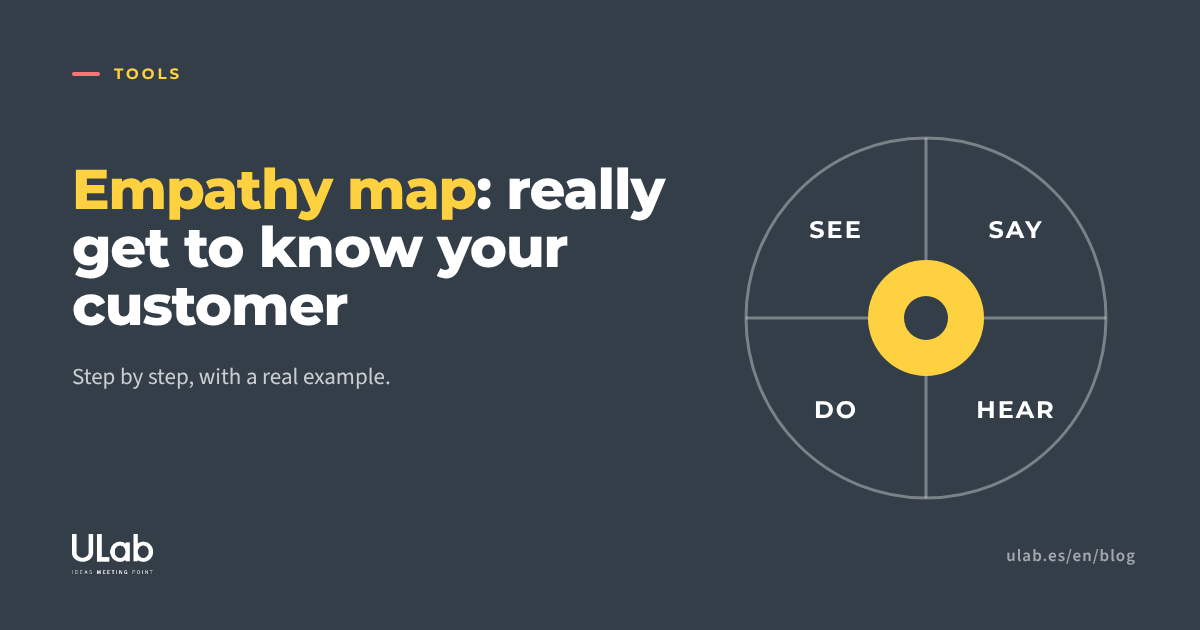
An empathy map is a visual canvas that helps a team put itself in the shoes of a specific customer. It organises what you know about that person into areas (what they see, say, do, hear, think and feel) so you can spot needs that aren’t obvious at first glance.
It was created at XPLANE, the visual thinking company founded by Dave Gray, as part of the Gamestorming toolkit, and it became a classic in design thinking. In 2017 Gray published an updated version of the canvas, which is the one we recommend using today (Dave Gray on Medium).
The six areas of the empathy map (2017 version)
The updated canvas starts with two questions that frame everything else:
• Who are we empathising with? A specific person, in a specific situation.
• What do they need to do? Their goal: something observable they need to get done.
Then come the areas, in this order:
- See: what they see in their environment, in the market, in what others do.
- Say: what they say out loud. Real quotes are gold here.
- Do: what they do, today, in practice. Behaviour, not intentions.
- Hear: what they hear from friends, colleagues, influencers, the media.
- Think & Feel: what goes on inside their head, separated from what you can observe.
- Pains and Gains: their fears, frustrations and anxieties (pains) and their wishes, needs and dreams (gains).
The 2017 version keeps Think & Feel inside the head on purpose: to separate what you observe from what you infer. It’s one of the most useful changes, because it stops you from inventing.
How to create an empathy map in 6 steps
- Choose one real person (or segment). “Small businesses” is too broad. “A freelance designer who’s just moved to Alicante” works.
- Gather real information first. Interviews, observation, customer emails, reviews, support tickets. The Nielsen Norman Group explains you can use empathy maps before, during or after research; if you start from assumptions, mark them and replace them with real data as you go (NN/g).
- Define their goal. What do they need to do? Write it at the top.
- Fill the outer areas clockwise: See, Say, Do, Hear. Use sticky notes, one idea per note.
- Fill the inside of the head: Think & Feel, then Pains and Gains.
- Look for patterns and contradictions. When someone says one thing and does another, there’s usually an opportunity. Share the map with your team and decide what you’ll change.
A 2026 warning: AI can help you group and summarise interview notes, but it shouldn’t invent quotes or users. The Nielsen Norman Group makes exactly this point in a recent article (NN/g). An empathy map full of made-up data is just a nice drawing.
Example:
Laura, a remote worker who has just moved to Alicante
• Who: Laura, 34, UX designer working remotely for a company in Amsterdam. She arrived in Alicante three months ago.
• Goal: to work productively and build a social life in a city where she knows no one.
• See: colleagues on Instagram enjoying the beach; cafés full of laptops; flyers in English she can’t always trust.
• Say: “I love the weather, but I spend all day talking to my screen.”
• Do: works from home, changes café twice a week, joins a language exchange on Thursdays.
• Hear: “You need a gestor for everything here”, “Alicante is very international”.
• Think & Feel: wonders if she made the right choice; feels isolated and a bit overwhelmed by the paperwork.
• Pains: loneliness, unstable Wi-Fi, no quiet place for client calls, bureaucracy.
• Gains: a routine, local friends, a professional place to meet clients, feeling part of the city.
With this map, a coworking (yes, like us) understands that Laura isn’t just looking for a desk: she’s looking for community and a soft landing. That changes how you talk to her, what you offer her and where you find her.
Empathy map, persona and value proposition: how they fit together
• Empathy map vs persona: a persona is a profile (who they are); an empathy map explores how they live a specific situation (what they experience). They complement each other.
• From empathy map to Value Proposition Canvas: the goal, pains and gains you’ve discovered fit directly into the customer profile of Strategyzer’s Value Proposition Canvas (jobs, pains and gains). It’s the natural next step to design a product that fits.
Run your empathy map workshop at ULab
An empathy map works best on a big wall, with sticky notes and your team in the same room. At ULab you can book a meeting room by the hour or one of our training classrooms for larger groups, right in the centre of Alicante.
Want to keep learning about your customers? Read our post on the types of entrepreneurs and the benefits of working in a business centre.
👉 Check availability and rates
FAQ
What are the parts of an empathy map?
The 2017 version has a goal and six areas: see, say, do, hear, think & feel, and pains and gains.
How long does it take to create an empathy map?
With research already done, a team can fill one in during a 60 to 90-minute session.
What’s the difference between an empathy map and a customer journey map?
An empathy map shows how a person thinks and feels in one situation; a customer journey map shows the steps they take over time with your brand.