
Working from home has given freedom in many forms, but do the hidden costs outweigh the benefits? Costs such as isolation, blurred boundaries, and a nagging feeling that something is missing. So here is the question that many remote workers are asking: is co-working worth it for a team that works remotely?
Let’s break it down for this breaking era of remote workers, AI, and digital nomads.
Why Remote Teams Are Looking at Co-Working Space
Working from home is flexible, comfortable, and free but research shows that there are underlying costs.
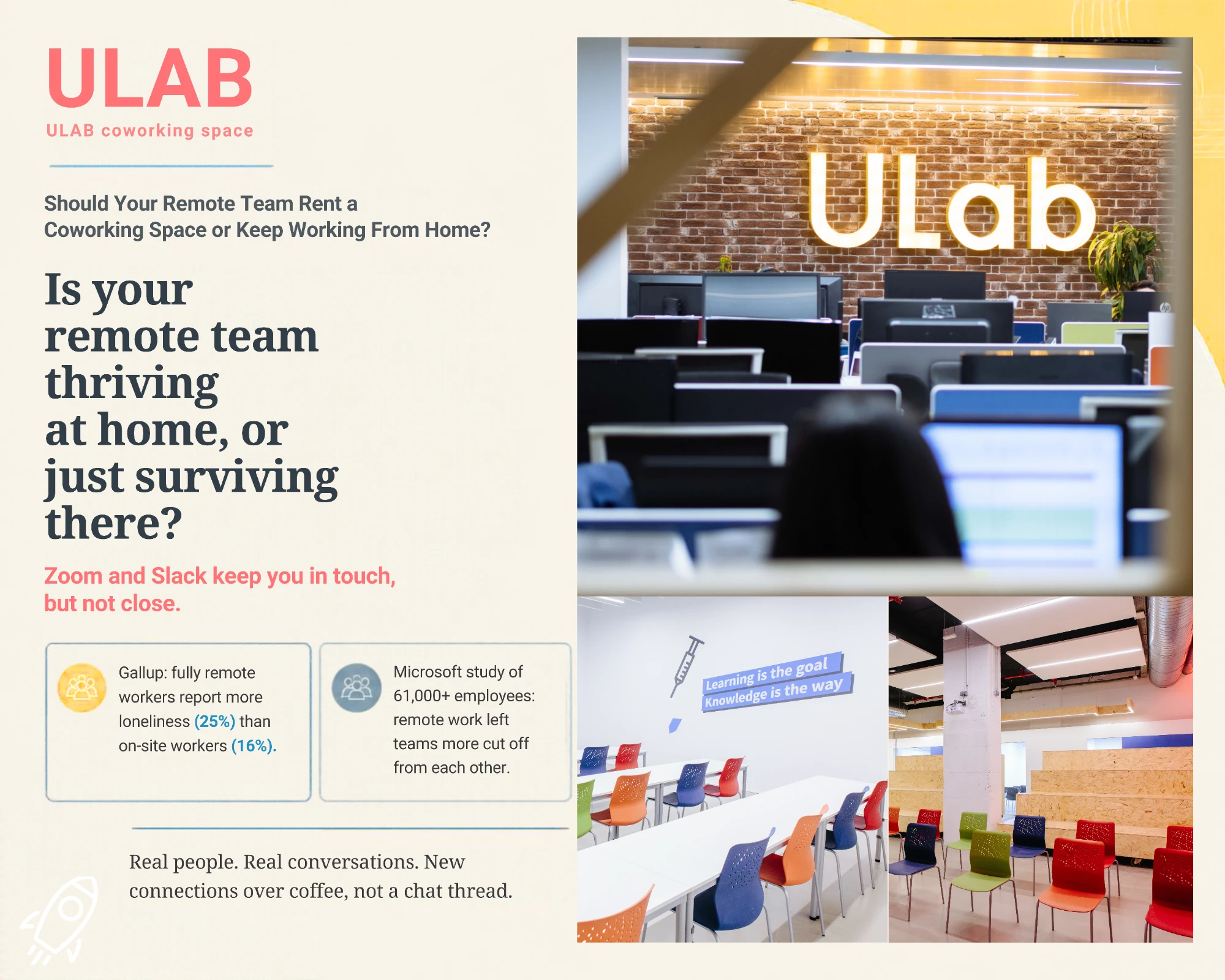
Isolation: Many people working from home feel the pressure of loneliness and isolation. Gallup’s State of the Global Workplace: 2024 report found that fully remote employees report significantly higher loneliness (25%) than those who work exclusively on-site (16%), with hybrid workers in between at 21%.
Blurred Boundaries: Separating work and home-life when it's the same environment can be stressful and hard to manage. In an Atlassian survey during the pandemic, more than half of respondents said it had become harder to maintain work-life boundaries.
Distractions: When working from home the distractions of everyday life become louder and harder to avoid. In IWG’s Global Workspace Survey of 15,000 people across 80 countries, 62% of home workers said family members demanding attention distracted them.
Team Connection: Yes, you may have Zoom or Slack to keep in touch with your team. However, there’s a noticeable distance when you can’t collaborate closely. When Microsoft went fully remote, a study of 61,000+ employees found people talked mostly with their inner circle and made new connections more slowly.
Co-Working offers a middle ground providing a professional workspace, without the long-term lease of a traditional office.
What Co-Working Gives Your Remote Team
Team reset: Even a short commute can create a clear start and end to your workday, which solves the issue of boundaries above.
Fewer Home Distractions: Having a defined workspace, clear of external distractions fixes the issue of distractions from home and having to share common spaces at your home like your kitchen or bedroom.
Reliable Infrastructure: Fast Wi-Fi, printers, designated meeting areas, and phone booths for calls.
Bookable Meeting Rooms: Great for client pitches, quarterly calls, and onboarding meetings without having to pay for a full-time office.
Community: Connect with other professionals and grow a community within the workplace that can lead to referrals, partnerships, or long-term friendships.
Flexibility: Join for a week free, pay for the day, by the month, or per event.
Where AI Fits Into Co-Working
AI tools such as Claude make remote work easier and more powerful than ever. Drafting, research, and analysis can happen from anywhere in today's world.
You no longer need a space for producing work. However, you need one for connecting, brainstorming, team days, workshops, and human moments that AI will never replace. Coworking lets you have those moments without paying for empty desks the rest of the month.
The Bottom Line
Remote work has answered the question of where we work, but it left another question open: how well we work, and how connected we feel while doing it.
A flexible coworking space is an affordable way to bring At ULAB, you’ll find the conversations, community, and new connections that a chat thread can’t give you, often over a cup of coffee.